
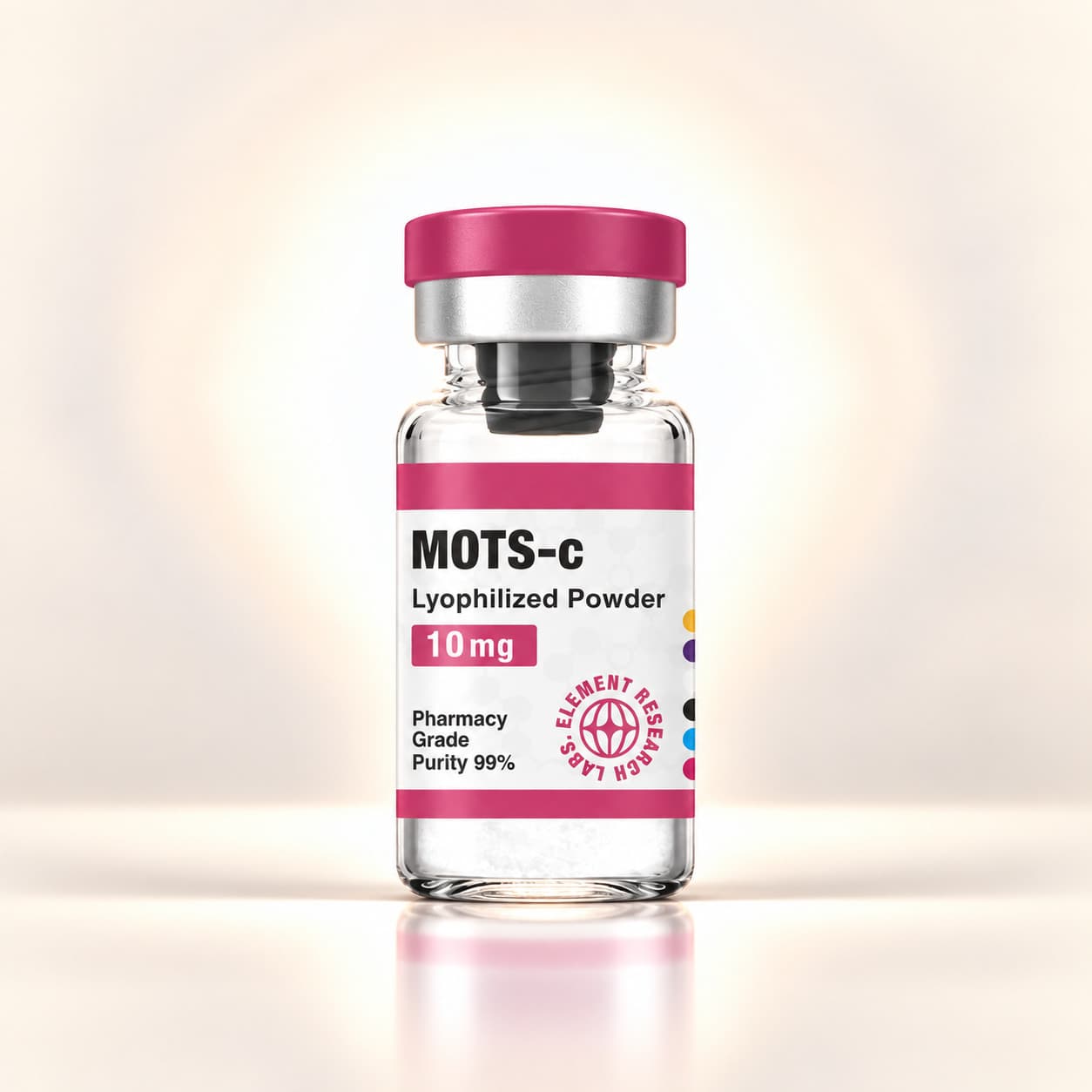
MOTS-c
Mitochondrial-derived 16-amino-acid peptide encoded in mitochondrial DNA
1 × $40 = $40. Applied in your cart.
- Every batch tested by an independent laboratory — identity by HPLC and mass spec.
- Dispatched on business days once payment has cleared. Free shipping over $100 — flat $10 otherwise.
- Discreet packaging, tracked and insured on every shipment.
For laboratory and research use only · Not for human consumption
- Certificate
- Record in preparation
- Sizes
- 10mg · 40mg
- Molecular weight
- 2174.5 g/mol
- Form
- Lyophilised powder, sealed glass vial
- Storage
- Cool, dry and dark; refrigerate once reconstituted
What we test, every batch.
Each production lot of MOTS-c is analysed by an independent laboratory before it ships. Its certificate is not in our published archive yet — we won't link one we don't hold.
Certificates we have publishedThe panel, every batch
- Identity
- HPLC + mass spec
- Purity
- HPLC · figure on the batch COA
- Net peptide content
- HPLC
- Heavy metals
- ICP-MS
- Sterility
- PCR
- Endotoxin
- USP <85>
What it is
MOTS-c is a 16-amino-acid peptide notable for where its instructions live: it is encoded within the mitochondrial 12S ribosomal RNA gene rather than in nuclear DNA. That places it in a small group of mitochondrial-derived peptides, and it is studied as an example of signalling that originates inside the mitochondrion and acts beyond it.
The peptide ships as a lyophilised powder in a sealed glass vial, available in 10 mg and 40 mg presentations. Each lot is accompanied by a Certificate of Analysis recording identity and chromatographic purity. Supplied as a laboratory reference material for research use only, and not for human or veterinary use.
What the research explores
Research on MOTS-c centres on mitonuclear communication, meaning how a mitochondrially encoded peptide influences events in the nucleus. Published work explores:
- Interaction with the folate-methionine cycle and the accumulation of AICAR
- AMPK pathway activation and downstream metabolic enzyme regulation in cell models
- Nuclear translocation of the peptide under metabolic stress conditions
- Sequence conservation and expression of mitochondrial-derived peptides across species
- Analytical detection of short mitochondrially encoded peptides in tissue
These describe published lines of scientific inquiry. Elements DNA makes no claim about metabolic, performance or health outcomes and supplies this compound strictly for in vitro and preclinical laboratory work.
Questions
How should the vial be stored?
Keep the sealed vial cool, dry and away from light until opened. After reconstitution, store refrigerated and treat the solution as short-lived. Repeated freeze-thaw cycles degrade peptide integrity.
How is the lyophilised powder reconstituted?
Solvent is typically added slowly down the inner wall of the vial and dissolved by swirling rather than shaking. The researcher sets solvent, concentration and protocol. We do not provide dosing or administration guidance of any kind.
What does the Certificate of Analysis cover?
The batch COA records compound identity and chromatographic purity for your specific lot, with its lot identifier and test date. It is a laboratory characterisation document rather than a clinical or regulatory approval.
What arrives in the shipment?
One sealed glass vial of lyophilised powder in the size selected, protectively packaged and labelled with its batch identifier. Reconstitution solvent and consumables are not included.
Literature
7 publications · 2016–2025
Peer-reviewed publications indexed on PubMed that discuss MOTS-c. Listed for reference only — inclusion is not a claim about this product or its effects.
- 2025MOTS-c-modified functional self-assembly peptide hydrogels enhance the activity of nucleus pulposus-derived mesenchymal stem cells of intervertebral disc degeneration
Lin Y, Yang RY, Li J, et al. · Materials today. Bio
PMID 40510834 · doi 10.1016/j.mtbio.2025.101872
- 2025MOTS-c attenuates lung ischemia-reperfusion injury via MYH9-Dependent nuclear translocation and transcriptional activation of antioxidant genes
Li X, Zhan F, Qiu G, et al. · Redox biology
PMID 40403491 · doi 10.1016/j.redox.2025.103681
- 2025MOTS-c mimics remote ischemic preconditioning in protecting against lung ischemia-reperfusion injury by alleviating endothelial barrier dysfunction
Wang DD, Xu B, Sun JJ, et al. · Free radical biology & medicine
PMID 39827923 · doi 10.1016/j.freeradbiomed.2025.01.016
- 2024MOTS-c modulates skeletal muscle function by directly binding and activating CK2
Kumagai H, Kim SJ, Miller B, et al. · iScience
PMID 39559755 · doi 10.1016/j.isci.2024.111212
- 2024Novel function of MOTS-c in mitochondrial remodelling contributes to its antiviral role during HBV infection
Lin C, Luo L, Xun Z, et al. · Gut
PMID 37788894 · doi 10.1136/gutjnl-2023-330389
Show 2 more publicationsShow fewer
- 2023MOTS-c: A potential anti-pulmonary fibrosis factor derived by mitochondria
Zhang Z, Chen D, Du K, et al. · Mitochondrion
PMID 37307934 · doi 10.1016/j.mito.2023.06.002
- 2016MOTS-c: A novel mitochondrial-derived peptide regulating muscle and fat metabolism
Lee C, Kim KH, Cohen P · Free radical biology & medicine
PMID 27216708 · doi 10.1016/j.freeradbiomed.2016.05.015
Products are supplied strictly for laboratory and research use. They are not for human or veterinary consumption, and have not been evaluated by the U.S. Food and Drug Administration for the diagnosis, treatment, cure, or prevention of any condition.