
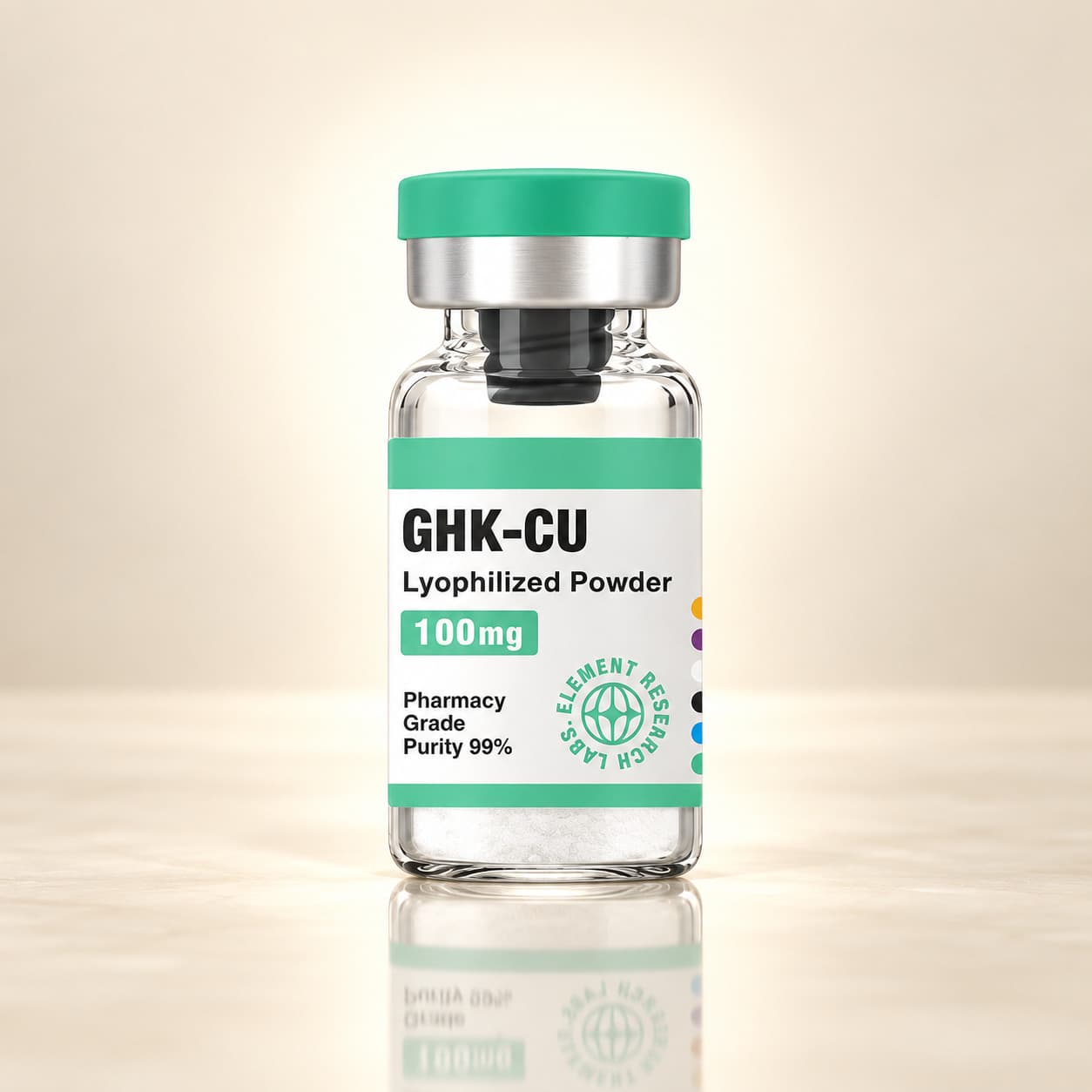
GHK-Cu
Copper-binding tripeptide, studied in matrix-protein and fibroblast research.
1 × $30 = $30. Applied in your cart.
- Every batch tested by an independent laboratory — identity by HPLC and mass spec.
- Dispatched on business days once payment has cleared. Free shipping over $100 — flat $10 otherwise.
- Discreet packaging, tracked and insured on every shipment.
For laboratory and research use only · Not for human consumption
- Certificate
- 99.79% purity
- Size
- 100mg
- Molecular weight
- 340.4 g/mol (GHK tripeptide)
- Form
- Lyophilised powder, sealed vial
- Storage
- Cool, dry and out of direct light; refrigerate once reconstituted
Measured, not claimed.
Purity by HPLC
From this lot's own certificate, published exactly as the laboratory issued it.
- Lot
- 1500-501
- Tested
- Jun 29, 2026
- Laboratory
- Pacific Coast Biologics Inc
1 earlier lot is in the archive.
Measured on this lot
- Appearance
- Lyophilized Powder
- Identity Confirmation
- 15.2% Acetonitrile
- Molecular Formula
- C₁₄H₂₄CuN₆O₄
- Molecular Weight
- 403.92 Da
Analysed against
- Identity
- HPLC + mass spec
- Purity
- HPLC · figure on the batch COA
- Net peptide content
- HPLC
- Heavy metals
- ICP-MS
- Sterility
- PCR
- Endotoxin
- USP <85>
What it is
GHK is a tripeptide — glycyl-L-histidyl-L-lysine, three residues and nothing more. It occurs naturally in human plasma, where its concentration is reported to decline with age, and it has a high affinity for copper(II). Bound to that ion it becomes GHK-Cu, the complex that most of the literature refers to and the form supplied here.
It ships as a lyophilised powder in a sealed vial and is reconstituted in the laboratory. GHK-Cu is one of the few compounds in this catalogue where colour is a useful first check: properly complexed material carries a distinct blue cast rather than the white of an uncomplexed peptide.
What the research explores
GHK and its copper complex are studied largely in the context of extracellular matrix biology and copper transport.
Areas examined in the literature:
- Copper(II) binding, and transport of the ion between plasma proteins and cells
- Fibroblast behaviour in culture, including collagen and glycosaminoglycan production
- Expression of matrix metalloproteinases and their tissue inhibitors
- Gene-expression profiling, where the tripeptide has been reported to shift transcription across a broad set of human genes
- Dermal and connective-tissue wound models in animals
The work is preclinical and in vitro. GHK-Cu is supplied as a laboratory research material with no approved application in humans.
Questions
Why does the powder look blue?
The blue cast comes from the coordinated copper(II) ion. An uncomplexed GHK peptide is white, so colour is a quick visual indicator that the material is the copper complex rather than the free tripeptide. The COA is the actual confirmation.
Does the listed molecular weight include the copper?
No. The 340.4 g/mol figure is the GHK tripeptide itself. The copper complex is heavier, and the batch record states which figure the analysis was run against.
How is it stored?
Sealed and dry, keep it cool and out of direct light. Copper complexes are light-sensitive, so the dark storage note matters more here than for an uncomplexed peptide. Refrigerate once reconstituted.
What does the certificate of analysis cover?
Identity confirmation and purity by HPLC for the specific batch in your vial, with the batch identifier matching the vial label. We hold one for every run and will send the PDF on request.
Which lot is GHK-Cu's published certificate for?
Lot 1500-501, measured 99.79% by HPLC, tested Jun 29, 2026, by Pacific Coast Biologics Inc. The full certificate, including the laboratory's own assay rows, is published at /coa/8OO7ETGZVT.
Literature
8 publications · 2015–2026
Peer-reviewed publications indexed on PubMed that discuss GHK-Cu. Listed for reference only — inclusion is not a claim about this product or its effects.
- 2026Smart Healing for Wound Repair: Emerging Multifunctional Strategies in Personalized Regenerative Medicine and Their Relevance to Orthopedics
Arciola CR, Panichi V, Bua G, et al. · Antibiotics (Basel, Switzerland)
PMID 41594073 · doi 10.3390/antibiotics15010036
- 2025Topically applied GHK as an anti-wrinkle peptide: Advantages, problems and prospective
Mortazavi SM, Mohammadi Vadoud SA, Moghimi HR · BioImpacts : BI
PMID 39963574 · doi 10.34172/bi.30071
- 2024The glycyl-l-histidyl-l-lysine-Cu(2+) tripeptide complex attenuates lung inflammation and fibrosis in silicosis by targeting peroxiredoxin 6
Bian Y, Deng M, Liu J, et al. · Redox biology
PMID 38879894 · doi 10.1016/j.redox.2024.103237
- 2023Phenothiazine-Based Cu(II)-Selective Fluorescent Sensor: GHK-Cu Sensing Applications
Sahu R, Yadav S, Gunturu KC, et al. · The Journal of organic chemistry
PMID 37830186 · doi 10.1021/acs.joc.3c01600
- 2023Glycyl-l-histidyl-l-lysine-Cu(2+) rescues cigarette smoking-induced skeletal muscle dysfunction via a sirtuin 1-dependent pathway
Deng M, Zhang Q, Yan L, et al. · Journal of cachexia, sarcopenia and muscle
PMID 36905132 · doi 10.1002/jcsm.13213
Show 3 more publicationsShow fewer
- 2022Polyaspartic acid, 2-acrylamido-2-Methyl propane sulfonic acid and sodium alginate based biocompatible stimuli responsive polymer gel for controlled release of GHK-Cu peptide for wound healing
Sharma S, Anwar MF, Dinda AK, et al. · Journal of biomaterials applications
PMID 35341370 · doi 10.1177/08853282221076708
- 2018Regenerative and Protective Actions of the GHK-Cu Peptide in the Light of the New Gene Data
Pickart L, Margolina A · International journal of molecular sciences
PMID 29986520 · doi 10.3390/ijms19071987
- 2015GHK Peptide as a Natural Modulator of Multiple Cellular Pathways in Skin Regeneration
Pickart L, Vasquez-Soltero JM, Margolina A · BioMed research international
PMID 26236730 · doi 10.1155/2015/648108
Products are supplied strictly for laboratory and research use. They are not for human or veterinary consumption, and have not been evaluated by the U.S. Food and Drug Administration for the diagnosis, treatment, cure, or prevention of any condition.