
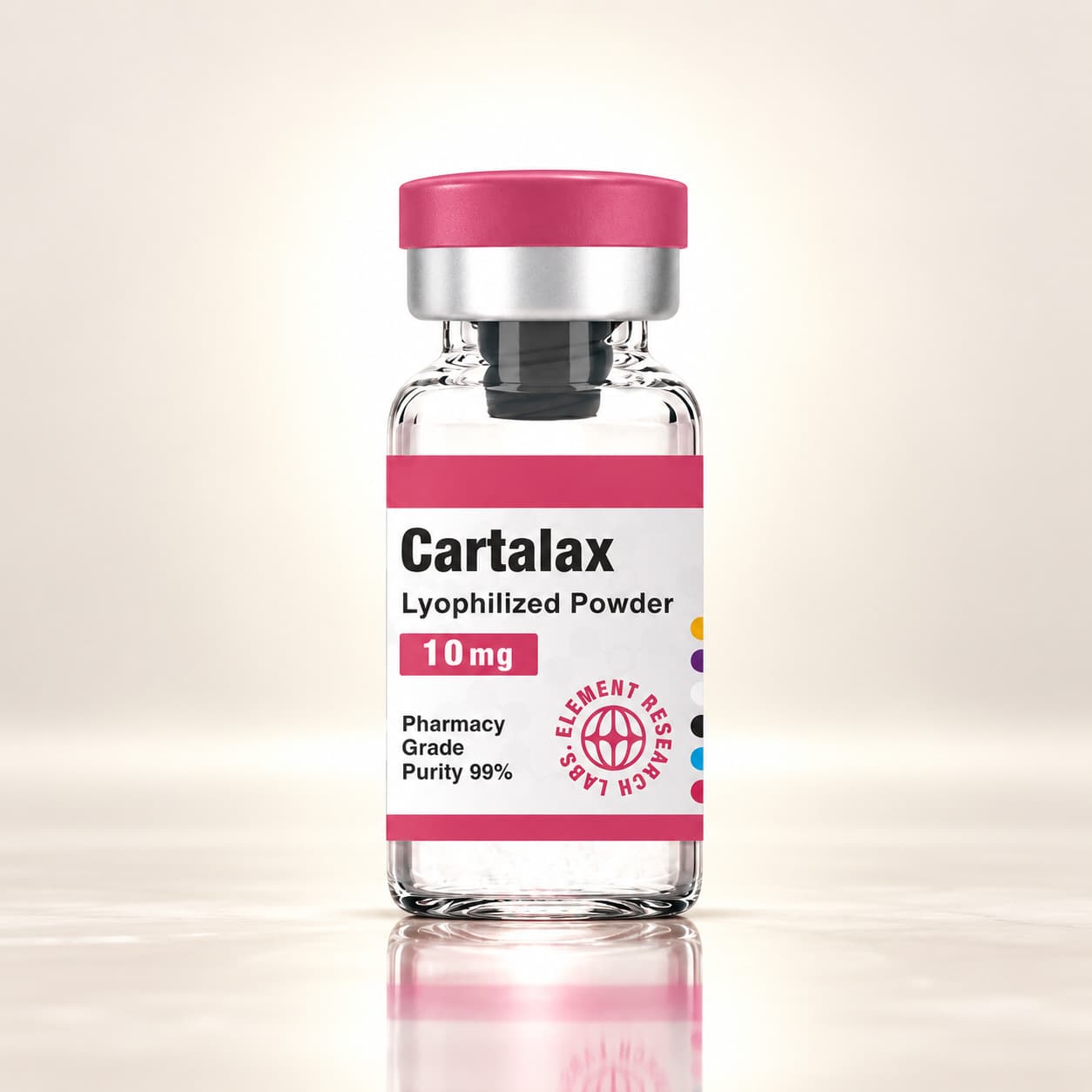
Cartalax
Synthetic Ala-Glu-Asp tripeptide, lyophilized vial
1 × $40 = $40. Applied in your cart.
- Every batch tested by an independent laboratory — identity by HPLC and mass spec.
- Dispatched on business days once payment has cleared. Free shipping over $100 — flat $10 otherwise.
- Discreet packaging, tracked and insured on every shipment.
For laboratory and research use only · Not for human consumption
- Certificate
- Record in preparation
- Class
- Synthetic tripeptide
- Form
- Lyophilized powder, sealed glass vial
- Storage
- Dry, cold and sealed
What we test, every batch.
Each production lot of Cartalax is analysed by an independent laboratory before it ships. Its certificate is not in our published archive yet — we won't link one we don't hold.
Certificates we have publishedThe panel, every batch
- Identity
- HPLC + mass spec
- Purity
- HPLC · figure on the batch COA
- Net peptide content
- HPLC
- Heavy metals
- ICP-MS
- Sterility
- PCR
- Endotoxin
- USP <85>
What it is
Cartalax is a synthetic tripeptide — alanyl-glutamyl-aspartic acid, abbreviated AED — from the family of short regulatory peptides catalogued in Khavinson research on tissue-specific peptide fragments. Its interest is structural rather than receptor-based: at three residues it is small enough to be studied as a direct nucleic-acid-interacting ligand rather than as a conventional receptor agonist, and the acidic side chains of glutamate and aspartate are what drive that binding hypothesis.
Made by solid-phase synthesis and shipped as a 10 mg lyophilized powder in a sealed glass vial. Supplied for laboratory research use only.
What the research explores
The short-peptide literature is concentrated in a small number of groups, and independent replication is limited. Areas of study include:
- Peptide-DNA and chromatin interaction models — the proposed mechanism by which a tripeptide could influence transcription without a receptor.
- Gene-expression readouts in chondrocyte and connective-tissue cell culture.
- Extracellular matrix protein assays in vitro, where the peptide is applied as a culture condition.
- Structure-activity comparison across the AED, KED and AEDG family, where single-residue changes are the variable.
- Stability of tripeptides in culture medium, since very short sequences are cleaved quickly.
We make no claim about outcomes in any organism, and note the evidence base here is narrower than for better-studied peptides.
Questions
How should the vial be stored?
Sealed and cold as a dry powder, protected from light. Very short peptides are stable lyophilized but degrade quickly once in solution at room temperature.
How well characterized is this compound?
Less than most items in this catalog. The short regulatory peptide literature comes largely from one research tradition and independent replication is limited — worth knowing before designing around it.
What does the Certificate of Analysis cover?
Identity and purity for the batch as determined by the testing lab, tied to the lot on the vial. It characterizes the material rather than clearing it for any application.
What arrives in the box?
One sealed glass vial containing a 10 mg lyophilized fill, labelled with compound and lot. No diluent is included.
Literature
6 publications · 2011–2020
Peer-reviewed publications indexed on PubMed that discuss Cartalax. Listed for reference only — inclusion is not a claim about this product or its effects.
- 2020Gene expression in human mesenchymal stem cell aging cultures: modulation by short peptides
Ashapkin V, Khavinson V, Shilovsky G, et al. · Molecular biology reports
PMID 32399807 · doi 10.1007/s11033-020-05506-3
- 2019Effect of short peptides on neuronal differentiation of stem cells
Caputi S, Trubiani O, Sinjari B, et al. · International journal of immunopathology and pharmacology
PMID 30791821 · doi 10.1177/2058738419828613
- 2016Peptide Regulation of Skin Fibroblast Functions during Their Aging In Vitro
Lin'kova NS, Drobintseva AO, Orlova OA, et al. · Bulletin of experimental biology and medicine
PMID 27259496 · doi 10.1007/s10517-016-3370-x
- 2015Peptide Regulation of Cells Renewal Processes in Kidney Tissue Cultures from Young and Old Animals
Chalisova NI, Lin'kova NS, Nichik TE, et al. · Bulletin of experimental biology and medicine
PMID 26033601 · doi 10.1007/s10517-015-2906-9
- 2014[Tripeptides slow down aging process in renal cell culture]
Khavinson VKh, Tarnovskaia SI, Lin'kova NS, et al. · Advances in gerontology = Uspekhi gerontologii
PMID 25946838
Show 1 more publicationShow fewer
- 2011Peptidergic regulation of thymocyte differentiation, proliferation, and apoptosis during aging of the thymus
Lin'kova NS, Polyakova VO, Trofimov AV, et al. · Bulletin of experimental biology and medicine
PMID 22238759 · doi 10.1007/s10517-011-1298-8

Products are supplied strictly for laboratory and research use. They are not for human or veterinary consumption, and have not been evaluated by the U.S. Food and Drug Administration for the diagnosis, treatment, cure, or prevention of any condition.