
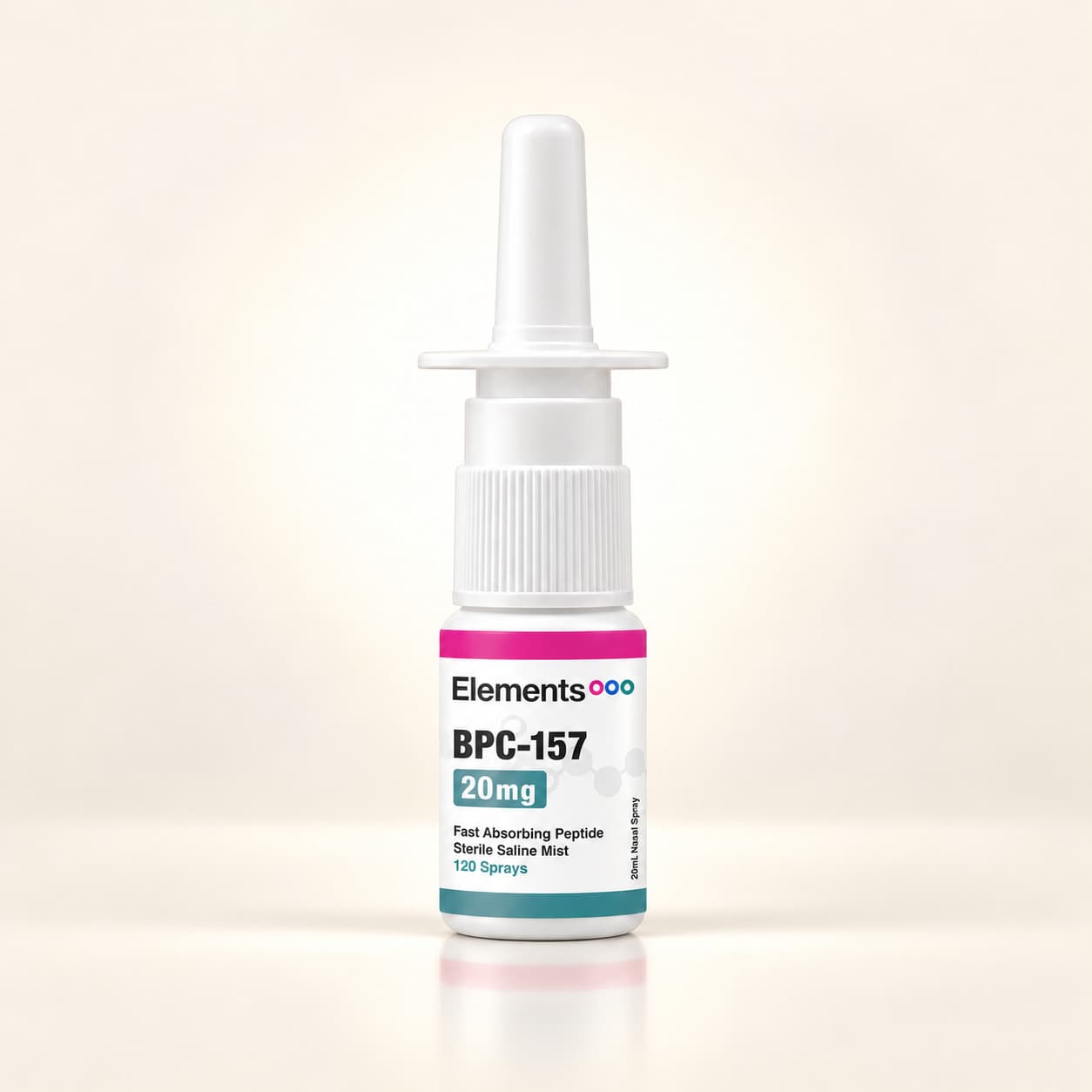
BPC-157 Nasal Spray
Synthetic pentadecapeptide, 20 mg in a 30 ml solution
1 × $60 = $60. Applied in your cart.
- Every batch tested by an independent laboratory — identity by HPLC and mass spec.
- Dispatched on business days once payment has cleared. Free shipping over $100 — flat $10 otherwise.
- Discreet packaging, tracked and insured on every shipment.
For laboratory and research use only · Not for human consumption
- Certificate
- From BPC-157 · 99.90% purity
- Class
- Synthetic pentadecapeptide
- Form
- Solution in sterile isotonic saline
Measured, not claimed.
Purity by HPLC
BPC-157 Nasal Spray is prepared from BPC-157. HPLC purity describes the peptide and carries into solution.
- Lot
- 1500-501
- Tested
- Jun 27, 2026
- Laboratory
- Pacific Coast Biologics Inc
Measured on the BPC-157 lot
- Appearance
- Lyophilized Powder
- Identity Confirmation
- 31.0% Acetonitrile
- Molecular Formula
- C₆₂H₉₈N₁₆O₂₂
- Molecular Weight
- 1,419.5 Da
Analysed against
- Identity
- HPLC + mass spec
- Purity
- HPLC · figure on the batch COA
- Net peptide content
- HPLC
- Heavy metals
- ICP-MS
- Sterility
- PCR
- Endotoxin
- USP <85>
What it is
BPC-157 is a synthetic pentadecapeptide — fifteen amino acids corresponding to a partial sequence of body protection compound, a protein identified in gastric juice. It is made by solid-phase synthesis rather than extracted from tissue. Its distinguishing physical property is stability: the sequence tolerates aqueous and acidic conditions better than most short peptides, which is why it appears in solution formats where other sequences would not hold up.
This listing ships it dissolved rather than lyophilized: 20 mg of BPC-157 in a sterile isotonic saline base, filled to 30 ml in a sealed bottle with a metered atomizing pump rated at roughly 120 actuations. No reconstitution step is involved. Supplied for laboratory research use only.
What the research explores
BPC-157 has a substantial preclinical literature, concentrated in a small number of research groups and almost entirely in rodent models. Areas of study include:
- Angiogenic signaling — VEGFR2 pathway activation and endothelial tube-formation assays in vitro.
- Fibroblast migration and granulation-tissue readouts in animal models.
- Nitric oxide system interaction — measured alongside NO synthase modulation in rodent work.
- Gut-brain axis signaling, including dopaminergic and serotonergic measurements.
- Aqueous and acid stability, which is what makes the peptide tractable in solution.
Independent replication outside the originating groups remains limited. We make no claim about effects in humans.
Questions
How should the bottle be stored?
Refrigerated, sealed and away from light. The sequence is unusually stable for a peptide, but a solution still keeps better cold than at room temperature.
Does anything need to be reconstituted?
No. The peptide is already in the saline base, so there is no bacteriostatic water or mixing step.
What does the Certificate of Analysis cover?
Identity and purity of the batch as determined by the testing lab, tied to the lot printed on the bottle. It characterizes the material only.
What arrives in the box?
One sealed 30 ml bottle with its metered pump, labelled with compound and lot. Research use only.
Which lot is BPC-157 Nasal Spray's published certificate for?
Lot 1500-501, measured 99.90% by HPLC, tested Jun 27, 2026, by Pacific Coast Biologics Inc. The full certificate, including the laboratory's own assay rows, is published at /coa/SXPR6UCKPL.
Literature
7 publications · 2011–2025
Peer-reviewed publications indexed on PubMed that discuss BPC-157 Nasal Spray. Listed for reference only — inclusion is not a claim about this product or its effects.
- 2025Regeneration or Risk? A Narrative Review of BPC-157 for Musculoskeletal Healing
McGuire FP, Martinez R, Lenz A, et al. · Current reviews in musculoskeletal medicine
PMID 40789979 · doi 10.1007/s12178-025-09990-7
- 2025Multifunctionality and Possible Medical Application of the BPC 157 Peptide-Literature and Patent Review
Józwiak M, Bauer M, Kamysz W, et al. · Pharmaceuticals (Basel, Switzerland)
PMID 40005999 · doi 10.3390/ph18020185
- 2022Pentadecapeptide BPC 157 and the central nervous system
Vukojevic J, Milavić M, Perović D, et al. · Neural regeneration research
PMID 34380875 · doi 10.4103/1673-5374.320969
- 2021Stable Gastric Pentadecapeptide BPC 157 and Wound Healing
Seiwerth S, Milavic M, Vukojevic J, et al. · Frontiers in pharmacology
PMID 34267654 · doi 10.3389/fphar.2021.627533
- 2019Gastric pentadecapeptide body protection compound BPC 157 and its role in accelerating musculoskeletal soft tissue healing
Gwyer D, Wragg NM, Wilson SL · Cell and tissue research
PMID 30915550 · doi 10.1007/s00441-019-03016-8
Show 2 more publicationsShow fewer
- 2018BPC 157 and Standard Angiogenic Growth Factors. Gastrointestinal Tract Healing, Lessons from Tendon, Ligament, Muscle and Bone Healing
Seiwerth S, Rucman R, Turkovic B, et al. · Current pharmaceutical design
PMID 29998800 · doi 10.2174/1381612824666180712110447
- 2011The promoting effect of pentadecapeptide BPC 157 on tendon healing involves tendon outgrowth, cell survival, and cell migration
Chang CH, Tsai WC, Lin MS, et al. · Journal of applied physiology (Bethesda, Md. : 1985)
PMID 21030672 · doi 10.1152/japplphysiol.00945.2010
Products are supplied strictly for laboratory and research use. They are not for human or veterinary consumption, and have not been evaluated by the U.S. Food and Drug Administration for the diagnosis, treatment, cure, or prevention of any condition.