
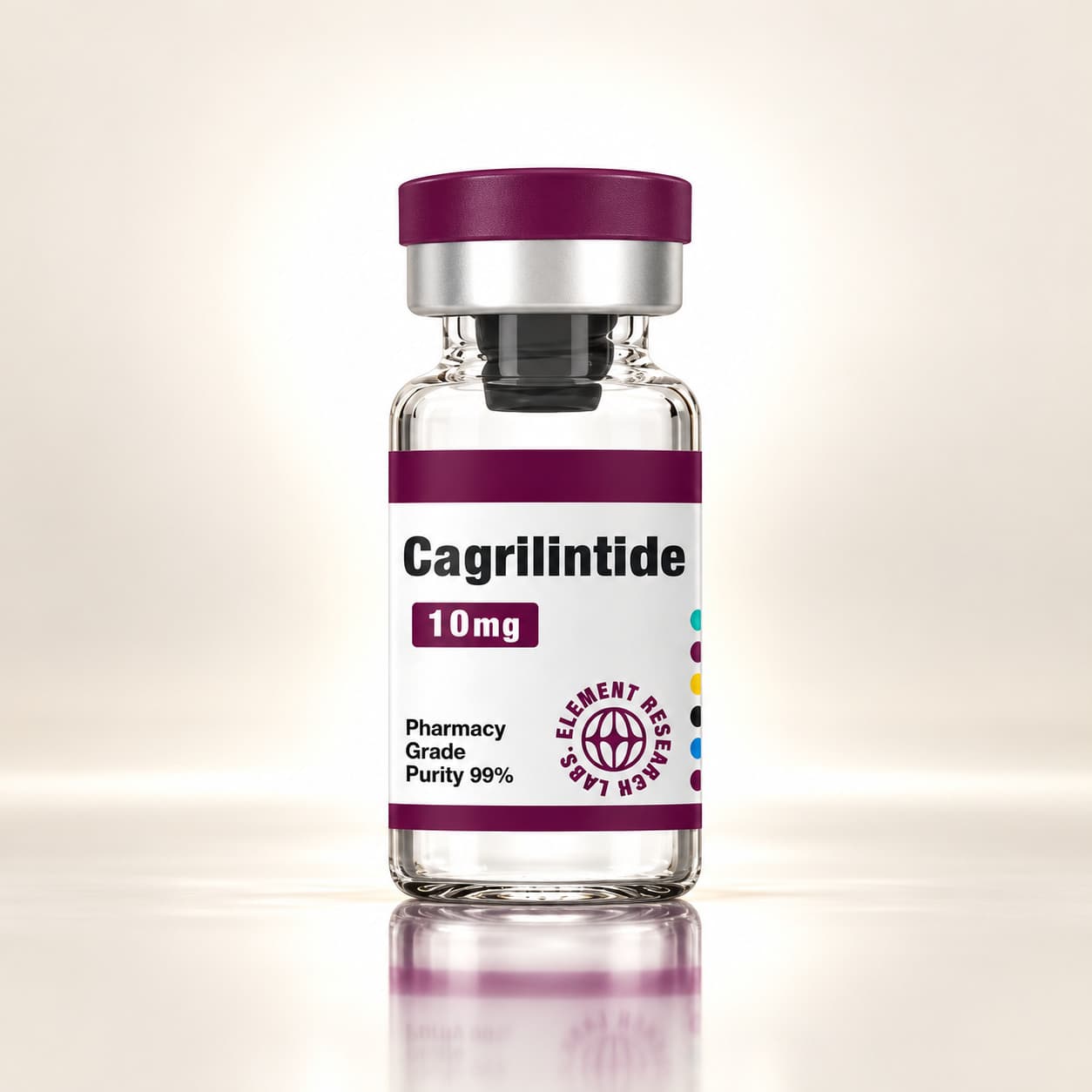
Cagrilintide
Long-acting amylin analogue studied at the calcitonin and amylin receptor complexes
1 × $50 = $50. Applied in your cart.
- Every batch tested by an independent laboratory — identity by HPLC and mass spec.
- Dispatched on business days once payment has cleared. Free shipping over $100 — flat $10 otherwise.
- Discreet packaging, tracked and insured on every shipment.
For laboratory and research use only · Not for human consumption
- Certificate
- Record in preparation
- Class
- Long-acting amylin analogue
- Molecular weight
- 3795.8 g/mol
- Form
- Lyophilised powder, sealed glass vial
- Storage
- Cool, dry and dark; refrigerate once reconstituted
What we test, every batch.
Each production lot of Cagrilintide is analysed by an independent laboratory before it ships. Its certificate is not in our published archive yet — we won't link one we don't hold.
Certificates we have publishedThe panel, every batch
- Identity
- HPLC + mass spec
- Purity
- HPLC · figure on the batch COA
- Net peptide content
- HPLC
- Heavy metals
- ICP-MS
- Sterility
- PCR
- Endotoxin
- USP <85>
What it is
Cagrilintide is a long-acting synthetic analogue of amylin, the pancreatic hormone co-secreted with insulin by beta cells. Sequence modifications and a lipid side chain slow its clearance relative to native amylin, which is what makes it useful as a tool compound for studying sustained receptor occupancy rather than the brief signalling burst the native hormone produces.
It ships as a lyophilised powder in a sealed glass vial, packaged for ambient-temperature transit and cold storage on arrival. Each lot is accompanied by a Certificate of Analysis covering identity and purity. Material is supplied for laboratory research use only and is not for human or veterinary use.
What the research explores
Cagrilintide is studied as a probe of the amylin receptor family, a set of heterodimers formed when the calcitonin receptor pairs with receptor activity-modifying proteins (RAMP1-3) to give the AMY1-3 subtypes. Published preclinical work explores:
- Binding affinity and selectivity across AMY1-3 and the calcitonin receptor
- Downstream cAMP accumulation and receptor desensitisation kinetics in cell lines
- How acylation alters plasma half-life and the duration of receptor engagement in rodent models
- Signalling behaviour when amylin and incretin receptor pathways are activated together in preclinical models
These describe directions of investigation reported in the scientific literature. Elements DNA makes no representation about outcomes in humans and supplies this material for in vitro and preclinical laboratory work only.
Questions
How should the vial be stored?
Keep the sealed vial cool, dry and out of direct light until it is opened. Once reconstituted, store it refrigerated and treat it as a short-lived solution. Avoid repeated freeze-thaw cycles, which degrade peptide integrity.
How is the lyophilised powder reconstituted?
Solvent is normally added slowly down the inside wall of the vial and the vial is swirled rather than shaken, since agitation can denature peptide material. Choice of solvent, concentration and protocol are determined by the researcher. We do not provide dosing or administration guidance of any kind.
What does the Certificate of Analysis cover?
The batch COA documents compound identity and chromatographic purity for the specific lot you receive, along with the lot identifier and test date. It is a laboratory characterisation document, not a clinical or regulatory approval.
What arrives in the shipment?
One sealed glass vial of lyophilised powder in protective packaging, labelled with its batch identifier. Reconstitution solvent, syringes, filters and other consumables are not included.
Literature
7 publications · 2021–2026
Peer-reviewed publications indexed on PubMed that discuss Cagrilintide. Listed for reference only — inclusion is not a claim about this product or its effects.
- 2026Structural and mechanistic insights into dual activation of cagrilintide in amylin and calcitonin receptors
Gu YM, Yuan QN, Li X, et al. · Acta pharmacologica Sinica
PMID 40847076 · doi 10.1038/s41401-025-01635-2
- 2026A cross-species atlas of the dorsal vagal complex reveals neural mediators of the effects of cagrilintide on energy balance
Ludwig MQ, Coester B, Gordian D, et al. · Nature metabolism
PMID 42260119 · doi 10.1038/s42255-026-01539-3
- 2026Distinct brain regions mediate regulation of food intake in response to GIPR agonism or antagonism
Lewis JE, Montaner M, Nuzzaci D, et al. · Nature metabolism
PMID 42498824 · doi 10.1038/s42255-026-01575-z
- 2025Structural and dynamic features of cagrilintide binding to calcitonin and amylin receptors
Cao J, Belousoff MJ, Johnson RM, et al. · Nature communications
PMID 40204768 · doi 10.1038/s41467-025-58680-y
- 2025Cagrilintide lowers bodyweight through brain amylin receptors 1 and 3
Carvas AO, Leuthardt A, Kulka P, et al. · EBioMedicine
PMID 40609154 · doi 10.1016/j.ebiom.2025.105836
Show 2 more publicationsShow fewer
- 2022
- 2021Development of Cagrilintide, a Long-Acting Amylin Analogue
Kruse T, Hansen JL, Dahl K, et al. · Journal of medicinal chemistry
PMID 34288673 · doi 10.1021/acs.jmedchem.1c00565
Products are supplied strictly for laboratory and research use. They are not for human or veterinary consumption, and have not been evaluated by the U.S. Food and Drug Administration for the diagnosis, treatment, cure, or prevention of any condition.