
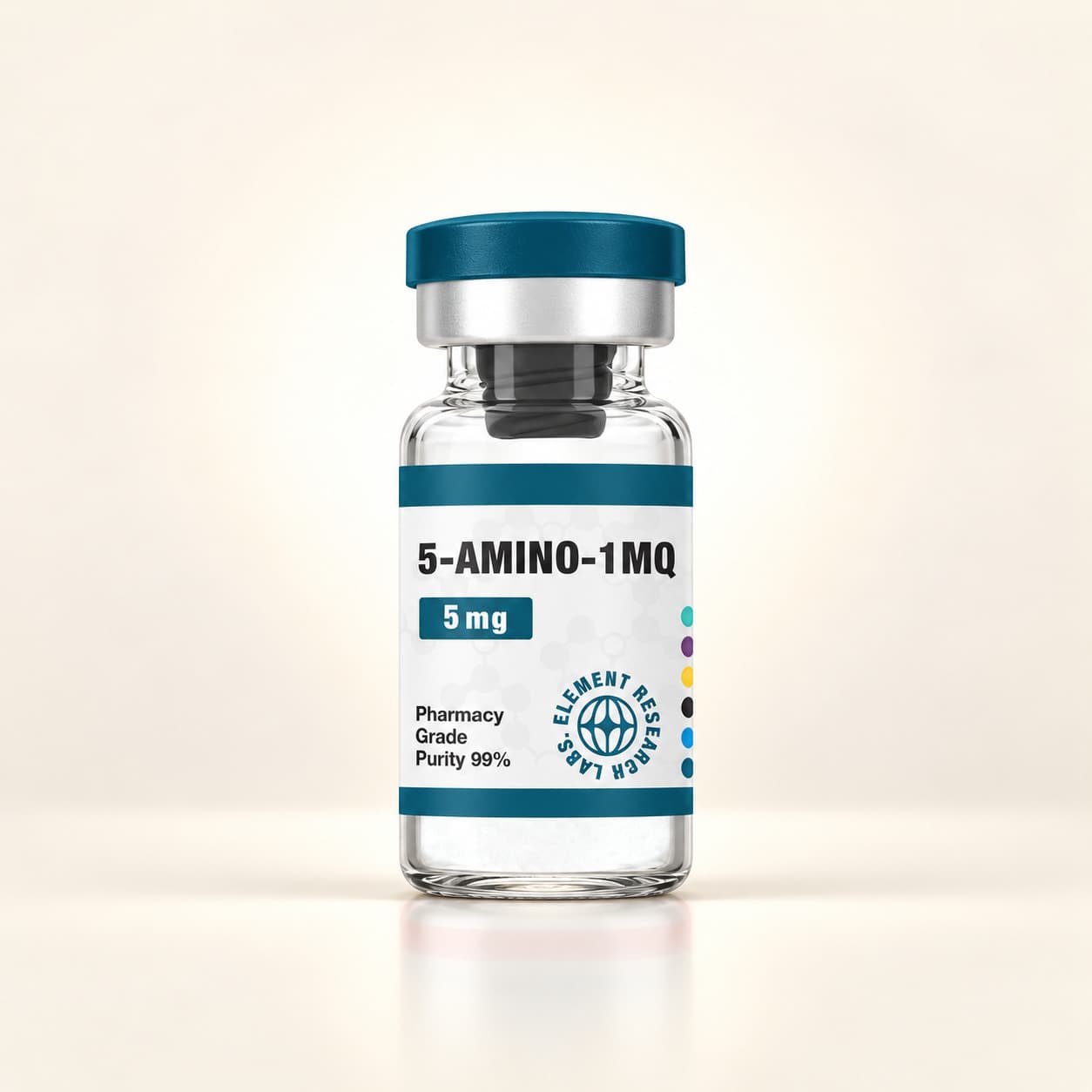
5-Amino-1MQ
Small-molecule NNMT inhibitor, 5 / 10 / 50 mg vials
- Every batch tested by an independent laboratory — identity by HPLC and mass spec.
- Dispatched on business days once payment has cleared. Free shipping over $150 — flat $12 otherwise.
- Discreet packaging, tracked and insured on every shipment.
For laboratory and research use only · Not for human consumption
- Certificate
- 99.60% purity
- Class
- Small-molecule enzyme inhibitor (not a peptide)
- Sizes
- 5mg · 10mg · 50mg
- Form
- Lyophilized powder, sealed glass vial
- Storage
- Dry, cold and sealed; protect from light
What it is
5-Amino-1MQ is not a peptide. It is a small molecule — a quinolinium salt, 1-methylquinolinium carrying an amino group at the 5-position, with a permanent positive charge on the ring nitrogen. That charge is central to how it behaves: the scaffold resembles the methylated product of nicotinamide N-methyltransferase (NNMT), which is the basis for its use as an inhibitor of that enzyme.
Shipped as a lyophilized powder in sealed glass vials, with 5 mg, 10 mg and 50 mg fills available. Because it is a small molecule rather than a peptide, its handling profile differs from most of this catalog — it is not subject to the same proteolytic and aggregation concerns. Supplied for laboratory research use only.
What the research explores
Research on this compound centres on one enzyme and the metabolic node it sits in. Areas of study include:
- NNMT enzymology — inhibition kinetics, binding mode and potency against the purified enzyme.
- Methyl-group and NAD+ balance — NNMT consumes both nicotinamide and S-adenosylmethionine, so inhibiting it perturbs the salvage route to NAD+ and the cellular methylation pool simultaneously.
- Selectivity profiling against other methyltransferases, which is the usual limiting question for a substrate-analog inhibitor.
- Adipocyte and hepatocyte metabolic assays in cell culture, where NNMT expression is high.
- Chemical stability of the quinolinium scaffold in solution.
Supplied as a research chemical. We make no claim about outcomes in any organism.
Questions
Is this a peptide?
No. It is a small organic molecule — a substituted quinolinium salt. It sits in this catalog because of the metabolic pathway it acts on, not because of its chemical class.
How should the vial be stored?
Sealed and cold as a dry powder, protected from light. Small molecules are generally more forgiving than peptides, but the quinolinium scaffold still keeps best dry.
What does the Certificate of Analysis cover?
Identity and purity of the batch as determined by the testing lab, tied to the lot on the vial. It is a characterization document, not a clearance for any use.
What arrives in the box?
One sealed glass vial of lyophilized powder at the selected size, labelled with compound and lot. No solvent is included.
Which lot is 5-Amino-1MQ's published certificate for?
Lot AMINO1Q2-501, measured 99.60% by HPLC, tested Jul 8, 2026, by Pacific Coast Biologics Inc. The full certificate, including the laboratory's own assay rows, is published at /coa/9XJGQDRKTU.
Literature
2 publications · 2021–2022
Peer-reviewed publications indexed on PubMed that discuss 5-Amino-1MQ. Listed for reference only — inclusion is not a claim about this product or its effects.
- 2022Reduced calorie diet combined with NNMT inhibition establishes a distinct microbiome in DIO mice
Dimet-Wiley A, Wu Q, Wiley JT, et al. · Scientific reports
PMID 35013352 · doi 10.1038/s41598-021-03670-5
- 2021Small molecule inhibitor of nicotinamide N-methyltransferase shows anti-proliferative activity in HeLa cells
Akar S, Duran T, Azzawri AA, et al. · Journal of obstetrics and gynaecology : the journal of the Institute of Obstetrics and Gynaecology
PMID 33645410 · doi 10.1080/01443615.2020.1854696
Products are supplied strictly for laboratory and research use. They are not for human or veterinary consumption, and have not been evaluated by the U.S. Food and Drug Administration for the diagnosis, treatment, cure, or prevention of any condition.