
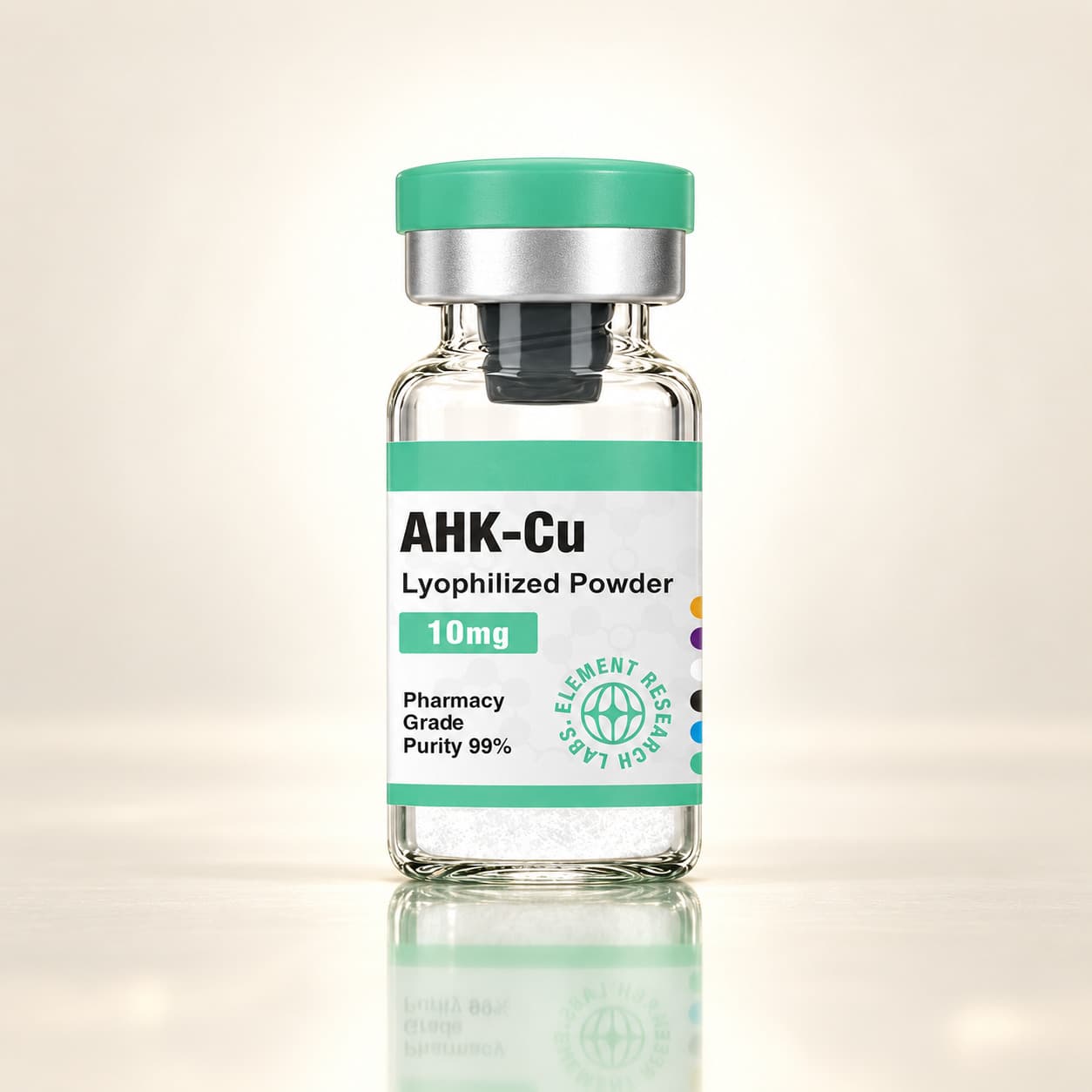
AHK-Cu
Copper-chelated Ala-His-Lys tripeptide, lyophilized
1 × $40 = $40. Applied in your cart.
- Every batch tested by an independent laboratory — identity by HPLC and mass spec.
- Dispatched on business days once payment has cleared. Free shipping over $100 — flat $10 otherwise.
- Discreet packaging, tracked and insured on every shipment.
For laboratory and research use only · Not for human consumption
- Certificate
- Record in preparation
- Class
- Copper(II) tripeptide complex
- Form
- Lyophilized powder, sealed glass vial
- Storage
- Dry, cold, sealed; protect from light and oxidation
What we test, every batch.
Each production lot of AHK-Cu is analysed by an independent laboratory before it ships. Its certificate is not in our published archive yet — we won't link one we don't hold.
Certificates we have publishedThe panel, every batch
- Identity
- HPLC + mass spec
- Purity
- HPLC · figure on the batch COA
- Net peptide content
- HPLC
- Heavy metals
- ICP-MS
- Sterility
- PCR
- Endotoxin
- USP <85>
What it is
AHK-Cu is the copper complex of the tripeptide alanyl-histidyl-lysine. The histidine imidazole and the backbone nitrogens coordinate a single copper(II) ion into a square-planar chelate — the same coordination chemistry that makes the better-known GHK-Cu complex stable. The copper is not an additive sitting alongside the peptide; it is part of the molecule, and the complex behaves differently from either the free tripeptide or a copper salt on its own.
Shipped as a 10 mg lyophilized powder in a sealed glass vial. Copper peptide complexes are light- and oxidation-sensitive, so the vial stays sealed and cold until reconstituted. Supplied for laboratory research use only.
What the research explores
AHK-Cu is studied largely as coordination chemistry and as a cell-culture reagent, often alongside its GHK-Cu analog. Areas of study include:
- Copper coordination — stability constants of the complex and how readily copper exchanges with cellular ligands such as albumin.
- Comparative studies against GHK-Cu, where a single residue difference at the first position is the variable.
- Matrix protein expression — collagen and related readouts in fibroblast culture, with the complex applied as an in vitro condition.
- Copper-dependent enzyme chemistry, including superoxide dismutase, where copper acts as a cofactor.
- Complex stability in aqueous buffer and across storage.
These are in vitro findings. We make no claim about outcomes in any organism.
Questions
How does this differ from GHK-Cu?
One residue. GHK-Cu is glycyl-histidyl-lysine; AHK-Cu substitutes alanine at the first position. The copper coordination geometry is comparable, and the two are frequently studied side by side.
How should the vial be stored?
Sealed and cold as a dry powder, away from light. Copper complexes are prone to oxidation, so limiting air exposure after opening matters.
What does the Certificate of Analysis cover?
Identity and purity for the batch as determined by the testing lab, tied to the lot on the vial. It is a characterization document, not a clearance for any use.
What arrives in the box?
One sealed glass vial containing a 10 mg lyophilized fill, labelled with compound and lot. No diluent is included.
Literature
1 publication · 2007
Peer-reviewed publications indexed on PubMed that discuss AHK-Cu. Listed for reference only — inclusion is not a claim about this product or its effects.
- 2007The effect of tripeptide-copper complex on human hair growth in vitro
Pyo HK, Yoo HG, Won CH, et al. · Archives of pharmacal research
PMID 17703734 · doi 10.1007/BF02978833
Products are supplied strictly for laboratory and research use. They are not for human or veterinary consumption, and have not been evaluated by the U.S. Food and Drug Administration for the diagnosis, treatment, cure, or prevention of any condition.