
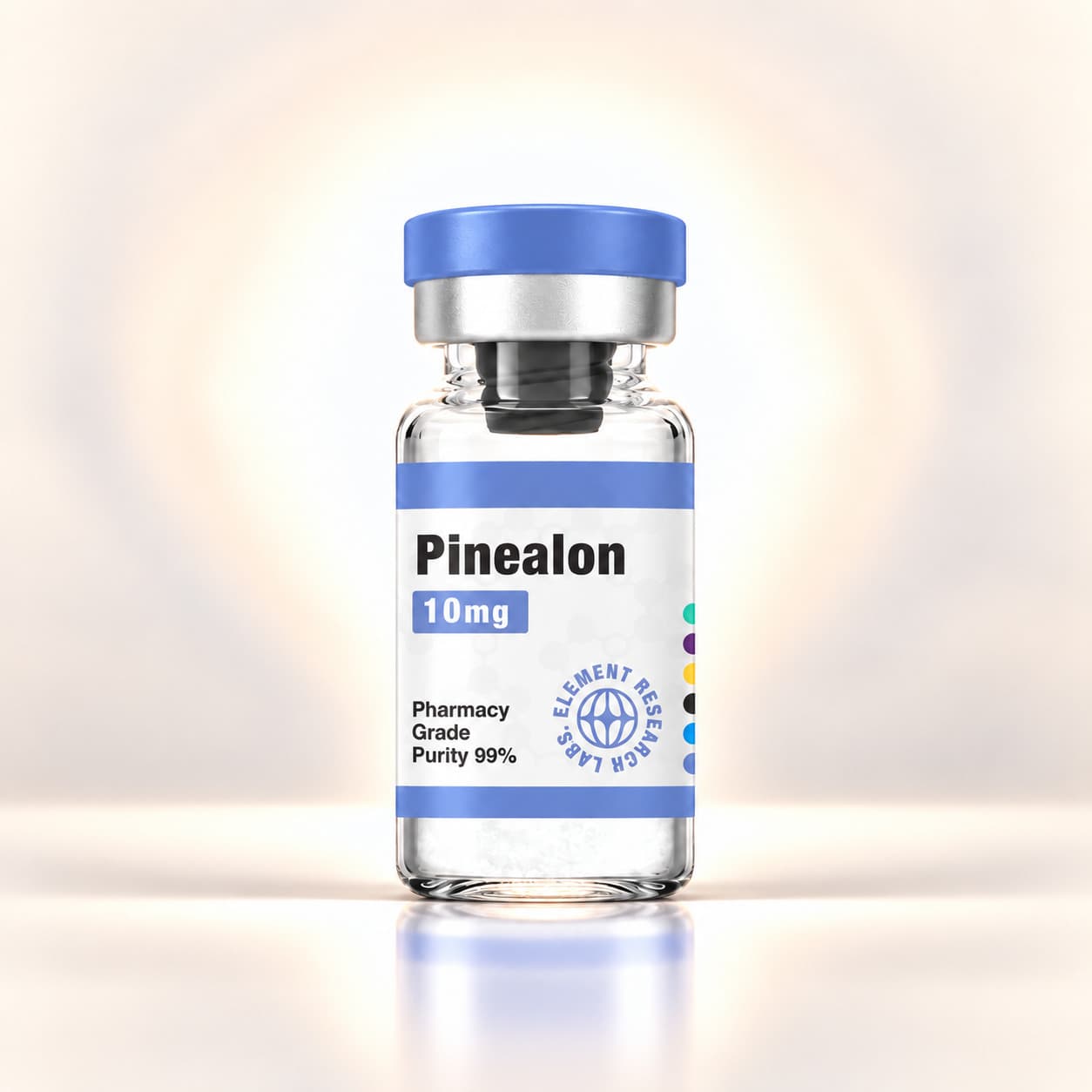
Pinealon
Short peptide bioregulator (Glu-Asp-Arg), studied in neuronal cell models.
1 × $30 = $30. Applied in your cart.
- Every batch tested by an independent laboratory — identity by HPLC and mass spec.
- Dispatched on business days once payment has cleared. Free shipping over $100 — flat $10 otherwise.
- Discreet packaging, tracked and insured on every shipment.
For laboratory and research use only · Not for human consumption
- Certificate
- Record in preparation
- Class
- Short peptide bioregulator
- Molecular weight
- 415.4 g/mol (per batch record)
- Form
- Lyophilised powder, sealed vial
- Storage
- Cool, dry and out of direct light; refrigerate once reconstituted
What we test, every batch.
Each production lot of Pinealon is analysed by an independent laboratory before it ships. Its certificate is not in our published archive yet — we won't link one we don't hold.
Certificates we have publishedThe panel, every batch
- Identity
- HPLC + mass spec
- Purity
- HPLC · figure on the batch COA
- Net peptide content
- HPLC
- Heavy metals
- ICP-MS
- Sterility
- PCR
- Endotoxin
- USP <85>
What it is
Pinealon is a tripeptide — glutamic acid, aspartic acid, arginine — belonging to the class of short peptide bioregulators developed at the St. Petersburg Institute of Bioregulation and Gerontology. Compounds in that class are unusually small, typically two to four residues, and the working hypothesis behind them is that sequences this short can interact directly with DNA and chromatin rather than with cell-surface receptors.
Whether that hypothesis holds is an open research question, and the supporting literature is narrow and concentrated in a small number of groups. The material ships as a lyophilised powder in a sealed vial, reconstituted in the laboratory with bacteriostatic water.
What the research explores
Pinealon is examined within the short-peptide-bioregulator literature, a body of work that is small and concentrated in a handful of research groups.
Areas of study:
- Binding interactions with DNA and histone proteins in cell-free systems
- Neuronal cell survival in culture under experimental oxidative stress
- Expression of markers associated with programmed cell death in cultured cells
- Rodent behavioural studies following prenatal hypoxia models
Independent replication outside the originating institutions is limited, and this is best read as an early-stage literature rather than a settled one. Pinealon is supplied strictly as a research material with no approved application in humans.
Questions
What is a short peptide bioregulator?
It is a classification from a specific Russian research programme covering peptides of roughly two to four residues, proposed to act on transcription directly rather than through receptors. The term describes the research framework the compound comes from, not an established mechanism.
What does the certificate of analysis cover?
Identity confirmation and purity by HPLC for the specific batch in your vial, alongside the batch identifier on the label. Every synthesis run has one on file and we will send the PDF on request.
How should the vial be stored?
Sealed and dry, kept cool and out of direct light. Short peptides are stable in lyophilised form, so ambient transit temperature is expected and not a concern. Refrigerate once reconstituted.
What ships with the vial?
The sealed vial, labelled with its lot number. Reconstitution fluid and supplies are separate catalogue items and nothing arrives pre-mixed.
Literature
8 publications · 2008–2016
Peer-reviewed publications indexed on PubMed that discuss Pinealon. Listed for reference only — inclusion is not a claim about this product or its effects.
- 2016[Comparative analysis of different methods of geroprotective]
Myakotnykh VS, Torgashov MN, Egorin KV, et al. · Advances in gerontology = Uspekhi gerontologii
PMID 28539017
- 2015[Pinealon and Cortexin influence on behavior and neurochemical processes in 18-month aged rats within hypoxia and hypothermia]
Mendzheritsky AM, Karantysh GV, Ryzhak GA, et al. · Advances in gerontology = Uspekhi gerontologii
PMID 28509493
- 2013[Neuroprotective effects of peptides bioregulators in people of various age]
Umnov RS, Lin'kova NS, Khavinson VKh · Advances in gerontology = Uspekhi gerontologii
PMID 24738258
- 2012[Analysis of some parameters of biological age and adaptation possibilities of workers of locomotive brigades]
Nazimko VA, Morgul' EV, Petrova OA, et al. · Advances in gerontology = Uspekhi gerontologii
PMID 22708445
- 2012Pinealon protects the rat offspring from prenatal hyperhomocysteinemia
Arutjunyan A, Kozina L, Stvolinskiy S, et al. · International journal of clinical and experimental medicine
PMID 22567179
Show 3 more publicationsShow fewer
- 2011[Effects of introduction of short peptides before carotid artery occlusion on behaviour and caspase-3 activity in the brain of old rats]
Mendzheritskiĭ AM, Karantysh GV, Ivonina KO · Advances in gerontology = Uspekhi gerontologii
PMID 21809624
- 2011Penetration of short fluorescence-labeled peptides into the nucleus in HeLa cells and in vitro specific interaction of the peptides with deoxyribooligonucleotides and DNA
Fedoreyeva LI, Kireev II, Khavinson VKh, et al. · Biochemistry. Biokhimiia
PMID 22117547 · doi 10.1134/S0006297911110022
- 2008[Investigation of antihypoxic properties of short peptides]
Kozina LS · Advances in gerontology = Uspekhi gerontologii
PMID 18546825
Products are supplied strictly for laboratory and research use. They are not for human or veterinary consumption, and have not been evaluated by the U.S. Food and Drug Administration for the diagnosis, treatment, cure, or prevention of any condition.