
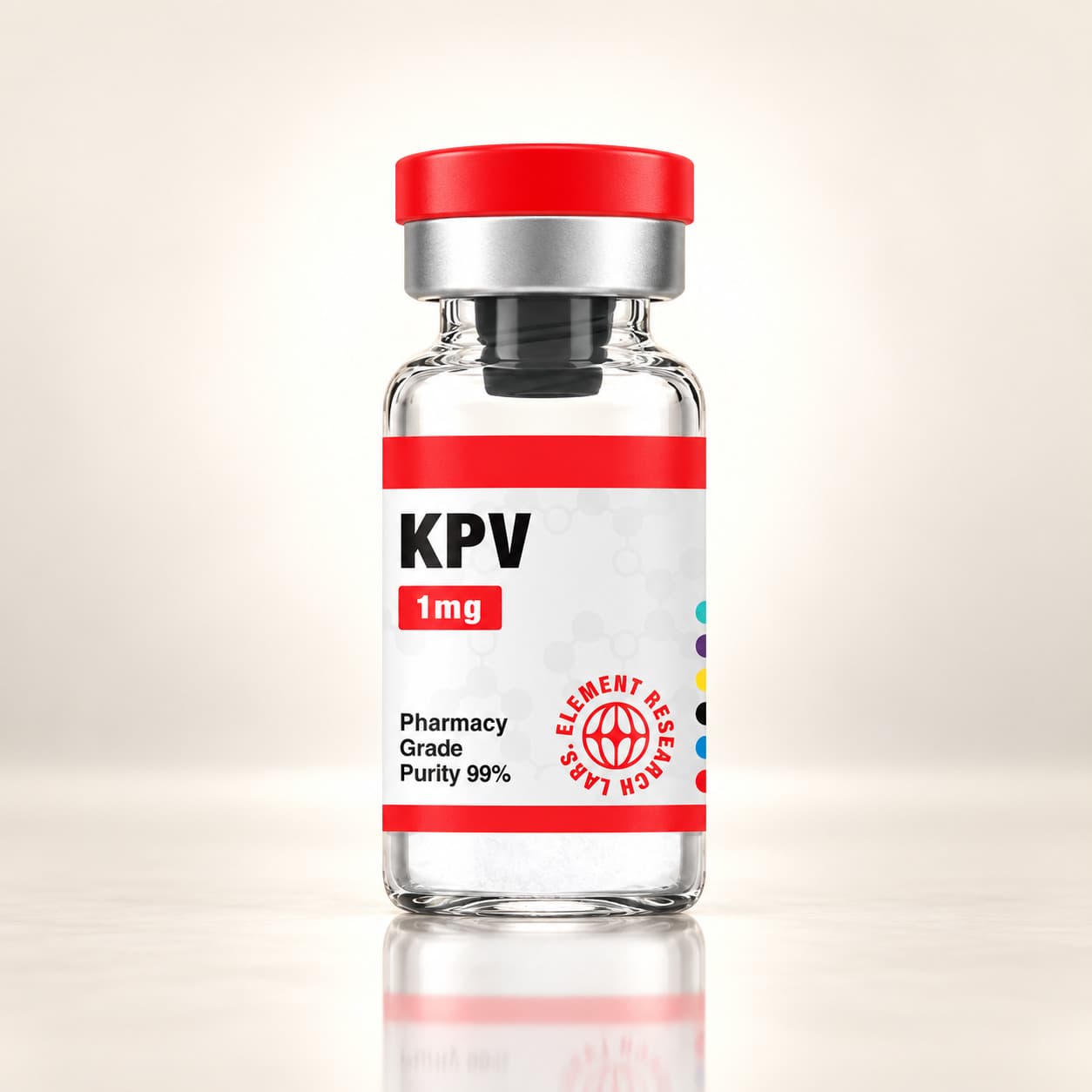
KPV
C-terminal tripeptide of α-MSH, studied in inflammatory-signalling models.
1 × $50 = $50. Applied in your cart.
- Every batch tested by an independent laboratory — identity by HPLC and mass spec.
- Dispatched on business days once payment has cleared. Free shipping over $100 — flat $10 otherwise.
- Discreet packaging, tracked and insured on every shipment.
For laboratory and research use only · Not for human consumption
- Certificate
- Record in preparation
- Size
- 1mg
- Molecular weight
- 401.5 g/mol (per batch record)
- Form
- Lyophilised powder, sealed vial
- Storage
- Cool, dry and out of direct light; refrigerate once reconstituted
What we test, every batch.
Each production lot of KPV is analysed by an independent laboratory before it ships. Its certificate is not in our published archive yet — we won't link one we don't hold.
Certificates we have publishedThe panel, every batch
- Identity
- HPLC + mass spec
- Purity
- HPLC · figure on the batch COA
- Net peptide content
- HPLC
- Heavy metals
- ICP-MS
- Sterility
- PCR
- Endotoxin
- USP <85>
What it is
KPV is the shortest molecule in this part of the catalogue: three residues — lysine, proline, valine — corresponding to the C-terminal end of α-melanocyte-stimulating hormone. The parent hormone is a thirteen-residue peptide; KPV is the tail of it, made synthetically as a standalone sequence.
Because it carries that C-terminal fragment without the receptor-binding regions of the full hormone, KPV is used in the literature as a way to isolate one arm of α-MSH biology from the pigmentation signalling the whole molecule drives. It ships lyophilised in a sealed vial and is reconstituted in the laboratory with bacteriostatic water.
What the research explores
KPV appears in preclinical work concerned with inflammatory signalling, generally in cell culture and rodent models.
Areas of study:
- NF-κB pathway activity and nuclear translocation in cultured cells
- Pro-inflammatory cytokine expression in stimulated cell lines
- Experimental colitis models in rodents, examining mucosal inflammation endpoints
- Antimicrobial activity reported for the α-MSH C-terminal sequence against certain bacterial and fungal strains
- Uptake by intestinal epithelial peptide transporters, a transport question rather than an outcome question
Each of these describes what researchers have looked at. KPV is supplied strictly as a laboratory material and has no approved application in humans.
Questions
Why is the vial only 1 mg?
KPV is a three-residue peptide, so a milligram is a large number of molecules relative to a longer chain of the same mass. The vial size reflects how the compound is typically handled in laboratory work rather than a supply constraint.
What is it reconstituted with?
Bacteriostatic water is the usual choice for lyophilised peptides at this scale, and it is listed as a separate catalogue item. Nothing ships pre-mixed.
What does the certificate of analysis cover?
Identity confirmation and purity by HPLC for the batch in your vial, plus the batch identifier printed on the label. Every run has a COA on file and we will send the PDF on request.
How should the sealed vial be stored?
Cool, dry and out of direct light. Short tripeptides are stable as lyophilised powder, so ambient transit temperature is not a concern; refrigerate the vial once it has been reconstituted.
Literature
7 publications · 2000–2026
Peer-reviewed publications indexed on PubMed that discuss KPV. Listed for reference only — inclusion is not a claim about this product or its effects.
- 2026Lysine-proline-valine peptide attenuates hepatic lipid accumulation through ROS-dependent regulation of the PPARγ pathway in HepG2 cells
Lee JY, Lee J, Jung WK, et al. · Cytotechnology
PMID 42064835 · doi 10.1007/s10616-026-00967-z
- 2008PepT1-mediated tripeptide KPV uptake reduces intestinal inflammation
Dalmasso G, Charrier-Hisamuddin L, Nguyen HT, et al. · Gastroenterology
PMID 18061177 · doi 10.1053/j.gastro.2007.10.026
- 2008Melanocortin-derived tripeptide KPV has anti-inflammatory potential in murine models of inflammatory bowel disease
Kannengiesser K, Maaser C, Heidemann J, et al. · Inflammatory bowel diseases
PMID 18092346 · doi 10.1002/ibd.20334
- 2004alpha-Melanocyte-stimulating hormone, MSH 11-13 KPV and adrenocorticotropic hormone signalling in human keratinocyte cells
Elliott RJ, Szabo M, Wagner MJ, et al. · The Journal of investigative dermatology
PMID 15102092 · doi 10.1111/j.0022-202X.2004.22404.x
- 2003Dissection of the anti-inflammatory effect of the core and C-terminal (KPV) alpha-melanocyte-stimulating hormone peptides
Getting SJ, Schiöth HB, Perretti M · The Journal of pharmacology and experimental therapeutics
PMID 12750433 · doi 10.1124/jpet.103.051623
Show 2 more publicationsShow fewer
- 2000The neuropeptide alpha-MSH in host defense
Catania A, Cutuli M, Garofalo L, et al. · Annals of the New York Academy of Sciences
PMID 11268348 · doi 10.1111/j.1749-6632.2000.tb05387.x
- 2000The neuroimmunomodulatory peptide alpha-MSH
Ichiyama T, Sato S, Okada K, et al. · Annals of the New York Academy of Sciences
PMID 11268347 · doi 10.1111/j.1749-6632.2000.tb05386.x
Products are supplied strictly for laboratory and research use. They are not for human or veterinary consumption, and have not been evaluated by the U.S. Food and Drug Administration for the diagnosis, treatment, cure, or prevention of any condition.