
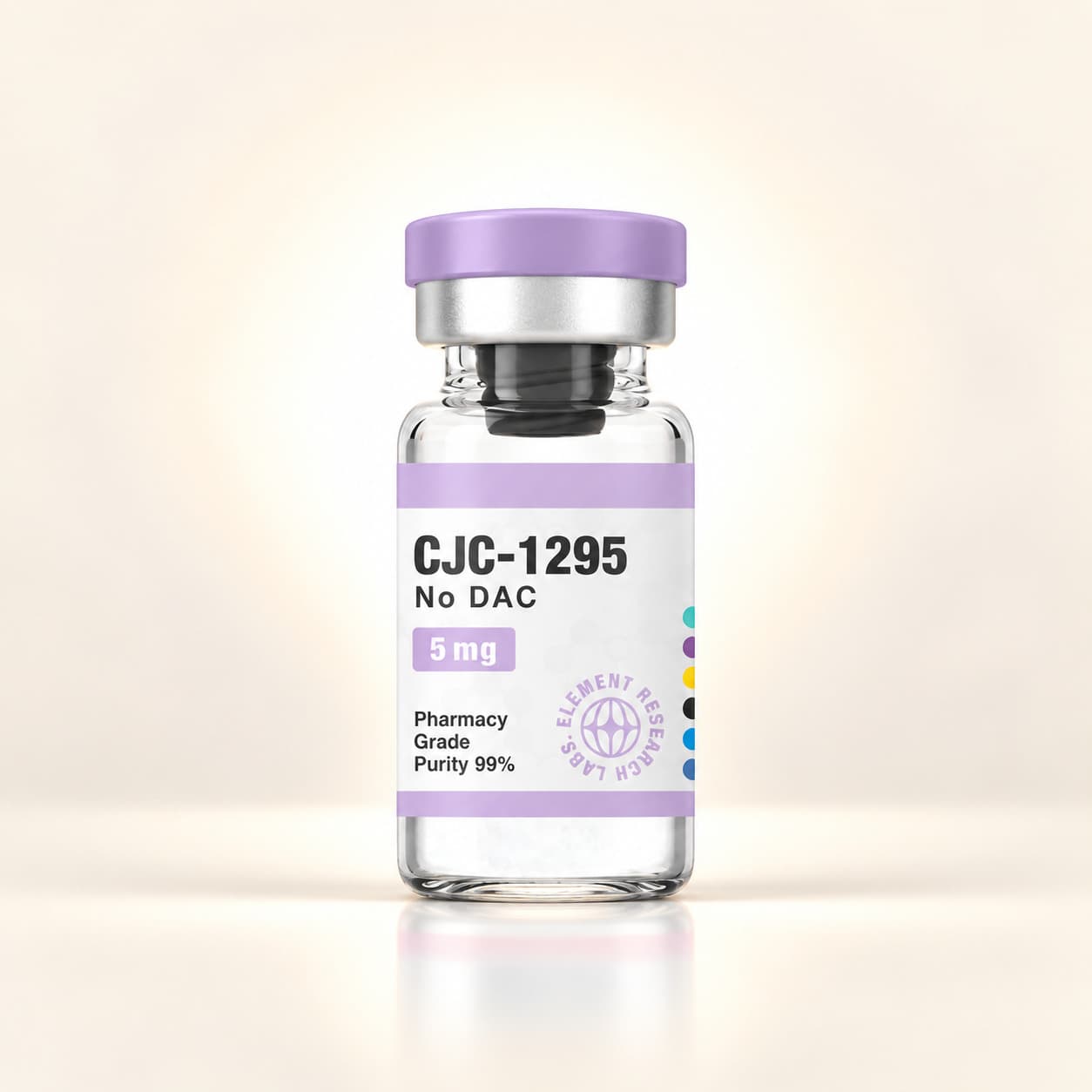
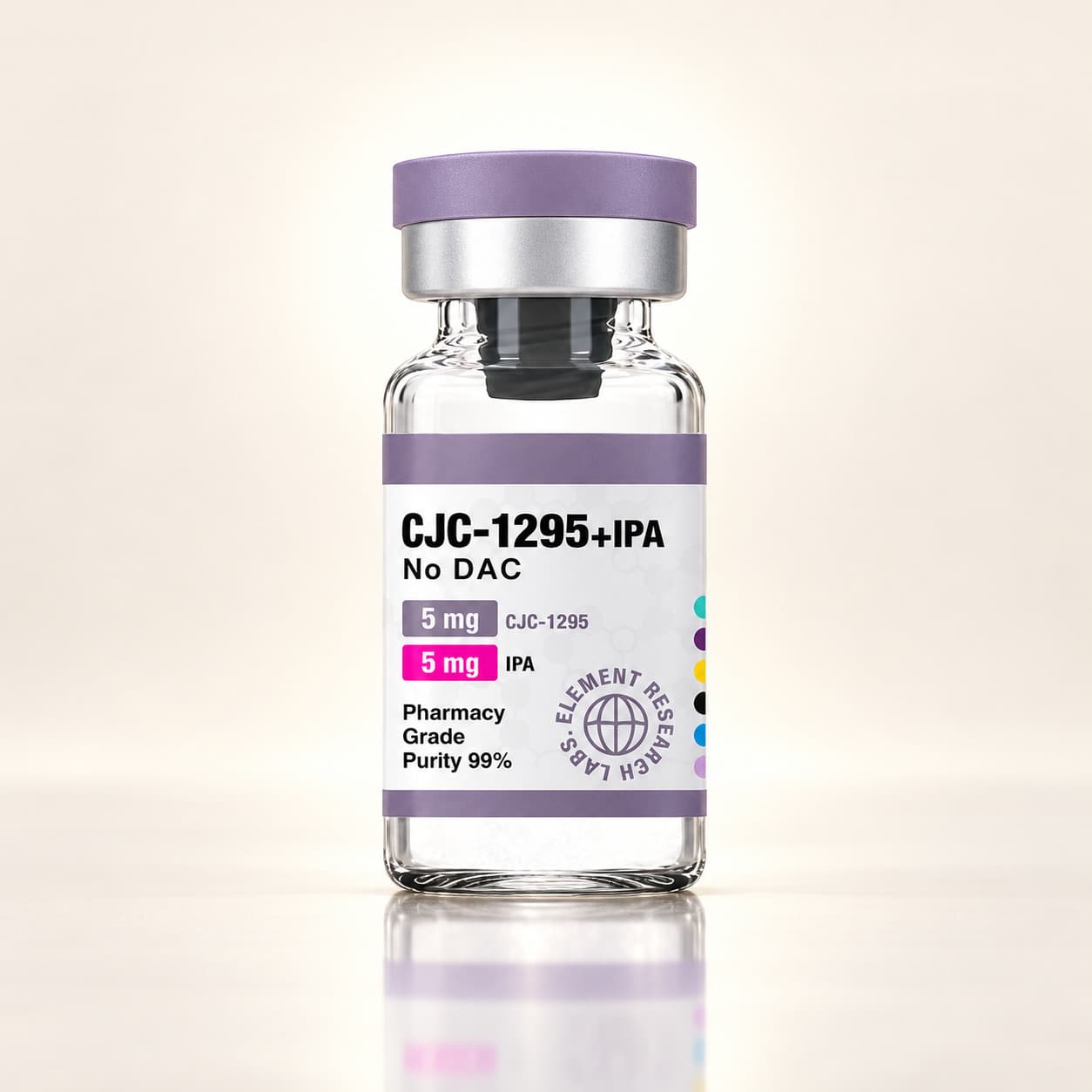
CJC-1295 (No DAC)
Modified GRF (1-29) analogue studied for GHRH receptor signalling and stability
1 × $15 = $15. Applied in your cart.
- Every batch tested by an independent laboratory — identity by HPLC and mass spec.
- Dispatched on business days once payment has cleared. Free shipping over $100 — flat $10 otherwise.
- Discreet packaging, tracked and insured on every shipment.
For laboratory and research use only · Not for human consumption
- Certificate
- Record in preparation
- Class
- Modified GRF (1-29) analogue, no DAC
- Size
- 5mg
- Molecular weight
- 3367.8 g/mol
- Form
- Lyophilised powder, sealed glass vial
- Storage
- Cool, dry and dark; refrigerate once reconstituted
What we test, every batch.
Each production lot of CJC-1295 (No DAC) is analysed by an independent laboratory before it ships. Its certificate is not in our published archive yet — we won't link one we don't hold.
Certificates we have publishedThe panel, every batch
- Identity
- HPLC + mass spec
- Purity
- HPLC · figure on the batch COA
- Net peptide content
- HPLC
- Heavy metals
- ICP-MS
- Sterility
- PCR
- Endotoxin
- USP <85>
What it is
CJC-1295 without DAC is a modified growth hormone-releasing factor analogue built on the GRF (1-29) sequence. Four amino acid substitutions are introduced to resist enzymatic cleavage, extending stability relative to unmodified GHRH while omitting the drug affinity complex that gives the DAC variant its far longer circulating profile. That single difference is why both forms appear side by side in comparative research.
The peptide ships as a lyophilised powder in a sealed glass vial in a 5 mg presentation. Each lot carries a Certificate of Analysis documenting identity and purity. Supplied as a laboratory reference material for research use only, and not for human or veterinary use.
What the research explores
The no-DAC form is used in the literature as a shorter-acting counterpart to DAC-conjugated GHRH analogues. Reported areas of study include:
- Resistance to dipeptidyl peptidase-4 cleavage conferred by the substituted residues
- GHRH receptor binding and cAMP generation in pituitary cell models
- Half-life and exposure comparisons between DAC and no-DAC constructs in preclinical species
- How stimulation frequency shapes somatotroph secretory patterns in animal models
- Analytical separation of the intact peptide from its degradation products
These are published research directions rather than claims. Elements DNA makes no representation about effects in humans and supplies this material for in vitro and preclinical laboratory use only.
Questions
How should the vial be stored?
Keep the sealed vial cool, dry and out of direct light before opening. After reconstitution, store it refrigerated and treat the solution as short-lived. Repeated freeze-thaw cycles degrade peptide integrity.
How is the lyophilised powder reconstituted?
Solvent is typically added slowly down the inner wall of the vial, then dissolved by gentle swirling rather than shaking. The researcher sets solvent, concentration and protocol. We do not provide dosing or administration guidance.
What is the difference between this and the DAC version?
This listing is the no-DAC form. The DAC variant carries an additional drug affinity complex that binds serum albumin and substantially lengthens its circulating half-life. The two are studied against each other precisely because of that difference; the underlying GRF (1-29) sequence is shared.
What arrives in the shipment?
One sealed 5 mg glass vial of lyophilised powder, protectively packaged and labelled with its batch identifier. Reconstitution solvent and consumables are not included.
Literature
7 publications · 2005–2026
Peer-reviewed publications indexed on PubMed that discuss CJC-1295 (No DAC). Listed for reference only — inclusion is not a claim about this product or its effects.
- 2026A new era of doping? Use of peptide and peptide-analog drugs in recreational and professional sport and bodybuilding: a critical review
Coutinho LFD, DE Oliveira Neves LF, Camilo RP · The Journal of sports medicine and physical fitness
PMID 41880199 · doi 10.23736/S0022-4707.26.17773-1
- 2022Early detection of cannabinoids in biological samples based on their affinity interaction with the growth hormone secretagogue receptor
Danila GM, Puiu M, Zamfir LG, et al. · Talanta
PMID 34736642 · doi 10.1016/j.talanta.2021.122905
- 2021Advances in the detection of growth hormone releasing hormone synthetic analogs
Memdouh S, Gavrilović I, Ng K, et al. · Drug testing and analysis
PMID 34665524 · doi 10.1002/dta.3183
- 2019A method for confirming CJC-1295 abuse in equine plasma samples by LC-MS/MS
Timms M, Ganio K, Steel R · Drug testing and analysis
PMID 30938069 · doi 10.1002/dta.2599
- 2016Netnography of Female Use of the Synthetic Growth Hormone CJC-1295: Pulses and Potions
Van Hout MC, Hearne E · Substance use & misuse
PMID 26771670 · doi 10.3109/10826084.2015.1082595
Show 2 more publicationsShow fewer
- 2010Identification of CJC-1295, a growth-hormone-releasing peptide, in an unknown pharmaceutical preparation
Henninge J, Pepaj M, Hullstein I, et al. · Drug testing and analysis
PMID 21204297 · doi 10.1002/dta.233
- 2005Human growth hormone-releasing factor (hGRF)1-29-albumin bioconjugates activate the GRF receptor on the anterior pituitary in rats: identification of CJC-1295 as a long-lasting GRF analog
Jetté L, Léger R, Thibaudeau K, et al. · Endocrinology
PMID 15817669 · doi 10.1210/en.2004-1286
Products are supplied strictly for laboratory and research use. They are not for human or veterinary consumption, and have not been evaluated by the U.S. Food and Drug Administration for the diagnosis, treatment, cure, or prevention of any condition.